10 Things You Need To Know About Guitar Players -Part 2-


3. Guitarists get upset when non-guitarists critique the way they play.

Only other guitarists are the ones who are allowed to offer constructive criticism…and other musicians in general, except drummers. Let’s not go there.

4. The stereotype of the long-haired-tattoo-infested-guitarist on drugs and alcohol has to end.

There is no one way to define us or spot us in a crowd. But we all have that feeling when we play. It’s hard to explain if you’re not infatuated with a guitar but it’s sort of like those euphoric emotions you get when you’re petting your dog except multiply that love by about 100,000.


5. Guitarists always argue amongst themselves on the topic of the world’s most talented player.

There will be those who say it’s Stevie Ray Vaughn, Eric Clapton, Jimi Hendrix, Santana, Slash, Tom Morello, etc. We never get to the answer – ever. If you don’t play guitar, please don’t voice your opinion or say that Kurt Cobain was the best. You’ll get chewed up and spit out alive.

6. You paid how much?

Guitarists don’t mind shelling out crazy amounts of money on their equipment and we can never ever have enough guitars. Whether it’s on the instrument or the boat-loads of other technological necessities (pedals, cables, strings, amps, etc) we love to buy more and more things to get our fill. Our homes are scattered with guitar related paraphernalia and we love every part of it, even it means tripping over stuff on a daily basis to support our addiction. PS there’s no cure for our addiction, so please give up.

 Next page
 Previous page

Read more

10 Things You Need To Know About Guitar Players -Part 3-


7. If a guitarist is in a band, his/her fellow band members become family.

This applies to most people in a band, no matter the instrument. We  end up spending so many hours hanging out and jamming that it’s hard not to become brutally attached to these people on a much deeper level than anybody else in our social circle. It’s because we all get it – that trance one enters when they’re playing their instrument cannot be compared to any other craft.

8. Guitarists get very angry at non-guitarist’s stupidity.

I can’t tell you how many times I’ve face-palmed because of other people’s incredible ignorance and lack of knowledge. For example, I’ve been asked if one my guitars is a lead and if the other is a rhythm guitar… I’ve also been asked if I play acoustic or electric. The best one: “do you get shocked from the strings on an electric guitar? That’s why you need a pick right?” Mind blown. Yeah that actually happened. One my ex’s also said the following: “You always play that song!” … he was referring to the way I was tuning my guitar. We broke up.


9. Guitarists are insanely protective of their gear.

We don’t find it cute when your four-year-old kid picks up our vintage 1960’s strat and starts slamming on the strings. If we do let you touch or hold our guitar(s), take off all of the jewelry on your hands and fingers and place it back in the case/stand gently. And PLEASE don’t bang it on anything, hold it and caress it like a baby…it’s not a “toy”.

10. Once a guitarist, always a guitarist.

Tread lightly if you’re considering this instrument. It will mesmerize your senses the moment you learn your first chord, the moment you successfully learn scales, the moment you’re finally able to play a song you love just by relying on your very own ability to hear. You’ll become so attached to this hobby, many of you will change your life around it – you’ll dream about playing on stage, you’ll start to make friends with other guitar enthusiasts, and you’ll never look back.


Read more

10 Things You Gotta Know About the Fingerboard -Page 4-

9.SHIFT YOUR GAZE 

By using a different graphic symbol for each chord tone as in Fig. 11, it’s easy to see how these five connecting C-chord shapes originate in open position with the circular C roots, the diamond-shaped Es, and the square Gs all happening simultaneously. Practice breaking each chord tone into its own discrete “dipper”—for Cmaj7, play all roots (Cs), followed by all 3’s (Es), all 5’s (Gs), and all 7’s (B’s)—to create unique arpeggios.

10.REDEFINE THE MAP 


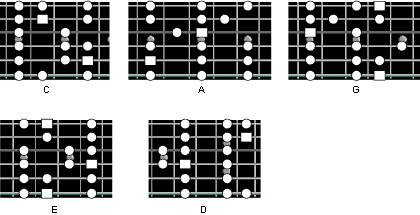
Finally, let’s have another look at Figures 1 and 2 from a more informed perspective. Fig. 12 organizes the 12-fret template of natural notes into five distinct C major scale patterns, each of which adheres to the root positions of its related chord shape. The entire template may be shifted up or down to transpose the whole fretboard to any key—up a half-step for C#/ Db, up a whole-step for D, up one-and-a-half steps for D#/Eb, and so on. Of course these are all virtual dots and position markers, so we have to train ourselves to visualize these patterns on demand. The “Big Dipper,” five major chord shapes, and five major scale patterns (which also contain all seven modes) provide a universal point of reference originating from any note in any position. Commit them to memory and you’ll never feel lost again!
Jesse Gress is the author of The Guitar Cookbook.

Previous page


Source Article : http://www.guitarplayer.com
Read more

10 Things You Gotta Know About the Fingerboard -Page 3-

6.TRAVEL THE SPACEWAYS 


See how the roots in Fig. 5 appear on the fifth and third strings? That’s because we’ve shifted the entire root template down one link and added the missing link one octave higher. This maps out all six A’s between the open and twelfth positions and creates a visual variation in our “Big Dipper,” but all we’re really doing is starting the same template from a different reference point. Fig. 6 bumps the template down another link to reveal six G’s, and Figures 7 and 8 continue the process with E’s and D’s respectively, until we come full circle back to C. Place the template anywhere on a 12-fret grid to immediately locate all six locations for any note, and then repeat it beginning 12 frets higher to cover the full range of the guitar. Why use C, A, G, E, and D as reference points? Glad you asked!

7.REDISCOVER YOUR ROOTS 

Our “Big Dipper” also provides a moveable template of all root locations and connections for the five basic open-string, major chord shapes—C, A, G, E, and D. (What’s that spell?) These are determined and named by their lowest possible fretboard positions, and each shape utilizes a different configuration of root notes, as confirmed by the memory-refreshing chord grids in Fig. 9. Always, and without exception, you’ll find the roots of these chord shapes located as follows:

“C” shape = roots on fifth and second strings.
“A” shape = roots on fifth and third strings.
“G” shape = roots on sixth, third, and first strings.
“E” shape = roots on sixth, fourth, and first strings.
“D” shape = roots on fourth and second strings.
(Did I mention always and without exception?) Line ’em all up on the grid, and…

8.CONNECT THE DOTS 

Fig. 10 shows how the C, A, G, E, and D shapes connect to form five different C-chord voicings between the 1st and 13th frets. This unifies the fretboard and illustrates how each shape connects via one or two root notes. Sing it with me now: “The “C” shape’s connected to the “A” shape, the “A” shape’s connected to the “G” shape, the “G” shape’s connected to the “E” shape, the “E” shape’s connected to the “D” shape, the “D” shape’s connected to the “C” shape,” and so on. Now, look deeper and…

Previous pageNext page


Read more

10 Things You Gotta Know About the Fingerboard -Page 2-

3.ADD ACCIDENTALS ON PURPOSE


The remaining five tones within any octave (an increment of 12 half-steps) are annotated using accidentals, or sharp and flat symbols. A sharp (#) raises a note by one half-step, while a flat (b) lowers it a half-step. Enharmonic notes occur when two different accidentals are used to indicate the same pitch, i.e., A#=Bb, C#=Db, D#=Eb, F#=Gb, and G#=Ab. The grid illustrated in Fig. 2 fills in the holes in Fig. 1 with all of the missing accidentals, completing the “big picture.” Think of it as your universe. Now, let’s start breaking down this giant cluster***k and find out what’s really going on here.

4.REPEAT YOURSELF
 
Fig. 3 diagrams the guitar’s five middle Cs on five different strings. (Fact: Standard guitar notation sounds an octave lower than written.) Notice how the notes on any pair of adjacent strings are equidistant (five frets apart) except between the second and third strings, where the distance is reduced by one fret. Once you realize that this relationship is always maintained regardless of what note you start with, you can find unisons on higher or lower strings by using the same formula, except in the extreme low and high registers where notes only appear once. (Lick of the Day: Pick any pitch that appears four times and play it sequentially on four adjacent strings. Repeat many times in either direction as quickly as possible.) Next, we add some octaves and…


5.ENTER THE MATRIX 

Any given note can be found in various octaves at six locations between open position and the 12th fret. Because the fretboard repeats itself one octave higher starting at the 13th fret, so do any notes and shapes you apply to it. In Fig. 4 we pinpoint on the matrix all Cs below the 12th fret, and connect them to form a six-point template that can be moved to any position on the fingerboard. Like a constellation, this “Big Dipper” maintains its shape as it floats around to different positions in the note matrix. As the “dipper” moves towards the nut, any points in the shape that vanish below open position reappear an octave higher below the 12th fret. Conversely, any points that rise above the 12th fret reappear starting at the 1st fret. Let’s get moving and…


Previous pageNext page


Read more

Why Guitar Players Need to Be Fit


Many years ago I bought a guitar exercise book written by Al Di Meola. The first two things he pointed out in the book was the importance of creating good habits and taking care of your health. I never forgot those two golden rules, although taking care of my health was something I had to learn the hard way. It took me a while to learn the major benefits of living a healthy life.
Body work outs, healthy foods, stress release, finger warm up exercises, taking care of your hearing, stretching, relaxation, etcetera are all part of the journey in becoming and staying a good guitar player. I know we don’t always have the time to work out and we all get into a slump once in a while. That’s okay. It’s part of life and it’s good to have a break now and then, but that’s no excuse to ignore that little voice in the back of your mind who knows what is best for you when you haven’t taken care of yourself the last couple of months or worse. So let’s pick it up where you left of. You know you’ll be a lot happier once you start working out. We are talking about your health here. It’s the most important thing!

Being fit will make you feel good about yourself. It gives you a more overall positive attitude. You will be more motivated to practice and more focused to achieve your musical goals. A good physical condition will also improve your performance on stage and in the studio when you’re recording.
So here are some tips to get you in good shape and stay motivated at all times:

Work out

Working out gives you more energy and a clear mindset. Something most of us need every now and then. Whether you experience a writers block, you can’t figure out why that solo isn’t working or when your practice session leads to nowhere, working out is a great moment to refresh your mind and get new inspiration. So let’s start today. Take a run outside, ride your bike, take a walk in the fresh air, do some push ups or stretching exercises. Working out outside is the best way to get you back in the saddle. If possible, run or ride to places where it’s quiet, where your mind can blow off some steam. Run to areas in your town where you don’t come everyday. It’s good for inspiration. Run where nature is. You’ll feel reborn.


Eat healthy, drink healthy

We all know why you should eat healthy. At least I hope so. Okay for those who have forgotten…
Healthy food is essential for gaining energy, preventing your body from getting sick and keeping you focused and inspired. Unhealthy food leads to laziness, unhappiness, obesity, etc. So this is a settled matter. We need to be in good shape to stay productive and positive.
As far as healthy drinks goes, drink water not soda. Drinking too much soda leads to blood pressure, concentration problems, anxiousness, sadness, tension, etc. Water on the other hand is essential for transporting the oxygen to your cells, flushing out toxins and protecting your joints ( a lot them in your fingers ) and organs. Like food water also gives you more energy and keeps you really focused.

Warming up exercises

To prevent your arms and hands from injuries you need to go through some warm up exercises before you really start playing. Releasing the tension in your finger muscles will make guitar playing run more smoothly and less stressful. You need a good blood flow and circulation to get your hands warmed up. It also wouldn’t be wise to run a few miles without stretching first. The same goes for guitar playing.
Warm up exercises are also great for speed development. So for you race cats out there this is the way to go. If you don’t have a lot of time, just take five minutes to go through some exercises. You’ll definitely feel the benefits. Check out some really good warmup exercises below. Have fun!

Protect your hearing

Besides your fingers, your ears are the most important tools you need in order to play guitar. Your hearing can go a long way but don’t underestimate the vulnerability of your ears. Long exposure to loud music can cause serious damage to your ears. Once you damaged your ears there is no way you can fix it, so don’t mess ‘m up. Whether you’re performing on stage or go to gigs, wear earplugs when you’re exposed to loud music. There are all kinds of earplugs that are designed for listening to music. If you perform on a regularly basis consider using an in-ear monitor system. In-ear monitoring is the replacement for traditional monitoring. All professional musicians use In-ear systems nowadays. It’s a great way to protect your hearing and having a consistent monitor performance.


Meditation

More and more research is discovering the benefits of meditation. While it’s not necessarily a must in becoming a great player, I do really recommend it. If you want to reduce stress, be more focused, motivated, productive and balanced, meditation will get you there. All these things will help you on the way towards your guitar goals. It also fuels inspiration, creativity and gives you a better insight on where you’re heading. It’s something you really need to experience over a period of time. It will change your life!
Health is not valued till sickness comes.- Dr. Thomas Fuller
If you like the post subscribe via email or RSS and I will notify you whenever I’ve written a new post. Thanx in advance!


Read more

What is CAGED System?

Have you ever come across the term CAGED System. I know I have. I used to think it meant barre chords because to me, the shape of the barre chord kind of looks like a cage-like shape. However, I realise that that is not what the CAGED system is.


Recently, I have been taking some guitar lessons (particularly on theory) to further improve my guitar theory because I am really weak at it. So, here's my attempt to explain what the CAGED system is:

CAGED is not a noun or verb etc. In fact, CAGED represents the open chords, C, A, G, E and D. These are the chords that most beginners would have learned first because they are pretty easy to play. In a nutshell, the CAGED system is all about movable chord patterns. So, what this CAGED system is trying to say is that you can use the chord patterns of C, A, G, E and D, to play all major chords.

I know it sounds kind of confusing, but perhaps some diagrams will help. Let us take the C major chord as an example. The diagrams you will see will show you how to play the C major chord using the CAGED system:


All the chords shown above are different ways you can play a C major chord using the CAGED system. Notice the red squares? These are the basic C, A, G, E and D chords that you probably already know how to play. The only difference is that you have to play them on different frets, and barre an extra fret.

So the next question to ask is, "How do we know which frets to play these patterns on?" This is again where you will need to know your fretboard well.

  • Diagram 1 - Ring finger is on the 3rd fret 5th string because it is a C note (C)
  • Diagram 2 - Index finger barres the 3rd fret 5th string because it is a C note (A)
  • Diagram 3 - Ring finger is on the 8th fret 6th string because it is a C note (G)
  • Diagram 4 - Index finger is on the 8th fret 6th string because it is a C note (E)
  • Diagram 5 - Index finger is on the 10th fret 4th string because it is a C note (D)
If it's still confusing, think of it as though you're using a capo. But this time, the capo is your index finger. 


I hope this post has helped. If it's still confusing, perhaps it's because my explanations are not clear. Do bear with me, I know my theory is not strong at all, therefore I'm trying my best to learn. I hope you all will take time to learn too =)
Read more

CAGED Guitar System: How To Make The Most Of It


CAGED Guitar System

The CAGED Guitar System Explained


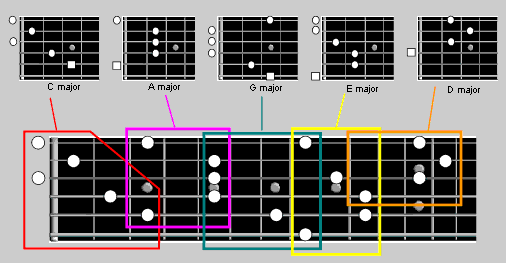
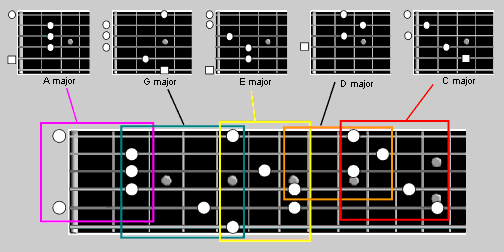
The CAGED guitar system can be very useful to help you find your way around the fretboard. The idea is based on the relationship between common major chord and major scale shapes. It is also a very useful method for visualising chord tones across the neck of the guitar. If you can easily find the notes on the fifth and sixth strings of the guitar then all it takes is a bit of practice with the CAGED system and you will be able to find any major chord tone very easily anywhere on the neck. There are two main things you need to learn. The first is the order of the chords always remains in the same sequence C A G E D starting from the C or if you were starting from the G then the order would be G E D C A because after the D chord it starts over again from the C. This makes more sense when you can see it in diagram form as shown below.


example1.gif

Study the picture above and note how the five chord patterns overlap with each other. Once you get used to visualising the CAGED chords across the neck like this you will find chord tones very easy. Don’t forget the order stays the same, G will always overlap with E etc. The next picture shows the same CAGED sequence starting from a different place to give you the idea.

example2.gif


The CAGED system also helps us with playing the major scales. As you have seen in the example above it’s quite easy to get used to the finding the chord tones anywhere on the neck as long as you can quickly find the root notes on the guitar strings. When you learn the major scale positions for the guitar it is a lot to have to remember. This gets even harder when you have to think about these positions in twelve different keys. By combining the major scales with the CAGED sequence of chords this task becomes much easier. By getting used to the relationship between the chords and the scales you will start to realise that remembering these scale positions and being able to find them in any key becomes a lot easier. Study the diagrams below and practice playing with these chord shapes and scales across the fretboard. It might seem a lot of work at first but you will get used to it quite quickly. The CAGED guitar system is a great method to help you find your way around the neck so keep at it and in a few months you should playing the guitar without thinking.


example3.gif


 source article : http://www.cagedguitarsystem.net/
Read more

10 Tips for Healthy Guitar Practicing


I’m gonna give you some straight talk about practicing guitar and taking good care of your body and hands.
This is especially relevant today since so many people are self taught from videos and don’t have a real life teacher for feedback.


Read more

CAGED Guitar System


The CAGED Guitar System Explained


The CAGED guitar system can be very useful to help you find your way around the fretboard. The idea is based on the relationship between common major chord and major scale shapes. It is also a very useful method for visualising chord tones across the neck of the guitar. If you can easily find the notes on the fifth and sixth strings of the guitar then all it takes is a bit of practice with the CAGED system and you will be able to find any major chord tone very easily anywhere on the neck. There are two main things you need to learn. The first is the order of the chords always remains in the same sequence C A G E D starting from the C or if you were starting from the G then the order would be G E D C A because after the D chord it starts over again from the C. This makes more sense when you can see it in diagram form as shown below.


example1.gif


Study the picture above and note how the five chord patterns overlap with each other. Once you get used to visualising the CAGED chords across the neck like this you will find chord tones very easy. Don’t forget the order stays the same, G will always overlap with E etc. The next picture shows the same CAGED sequence starting from a different place to give you the idea.


example2.gif

The CAGED system also helps us with playing the major scales. As you have seen in the example above it’s quite easy to get used to the finding the chord tones anywhere on the neck as long as you can quickly find the root notes on the guitar strings. When you learn the major scale positions for the guitar it is a lot to have to remember. This gets even harder when you have to think about these positions in twelve different keys. By combining the major scales with the CAGED sequence of chords this task becomes much easier. By getting used to the relationship between the chords and the scales you will start to realise that remembering these scale positions and being able to find them in any key becomes a lot easier. Study the diagrams below and practice playing with these chord shapes and scales across the fretboard. It might seem a lot of work at first but you will get used to it quite quickly. The CAGED guitar system is a great method to help you find your way around the neck so keep at it and in a few months you should playing the guitar without thinking.

example3.gif


Source Article : http://www.cagedguitarsystem.net

Read more

Quickest Way to Learn the Notes on a Guitar Fretboard


Step by step process for learning the fretboard notes


First, we need to understand what notes are and how they are written.

In their most basic form, notes are the pitch of a sound. For example, play any string on your guitar at any fret and it will sound a note.

The three note types

There are three types of note - natural, flat and sharp.

For example, an A natural note would simply be written as A.

An A flat note would typically be written as A♭ or Ab.

An A sharp note would typically be written as A♯ or A#.

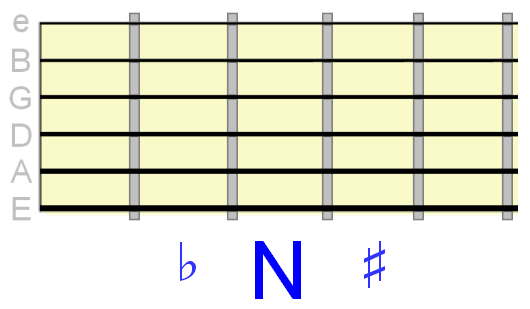
If we were to visualise the flat and sharp notes in relation to the natural note, we would see the natural in the middle with the flat on the left and sharp on the right...

A♭      A      A♯

So think of "flat" as one pitch/note "down" and sharp as one note "up" from a natural note.

On the fretboard, each fret represents a note, so the above relationship would appear as follows, with N being the natural note (on any string)...

natural, flat and sharp notes on a guitar fretboard


The musical alphabet


Just like on piano, there are 12 notes in total on guitar, which make up what is known as the chromatic scale. This means for every 12 frets on the guitar, starting at any fret on any string, you are covering the entire range of notes. Starting on the note A...

A A♯
B♭
B C C♯
D♭
D D♯
E♭
E F F♯
G♭
G G♯
A♭

The note after A♭/G♯ will be the note A - the sequence repeats every 12 notes. This 12 note sequence is known as the chromatic or 12 tone scale.

The pitches which have sharp and flat notes are known as enharmonic. A♯ and Bb are the same pitch (they are enharmonic), as are C♯ and D♭ etc. Which one we use depends on a few factors and you will learn what these are as you progress.

Now, you'll notice that some notes are not separated by sharps or flats - namely, B and C, E and F. This means that a B♯ would in fact be C. C♭ would be B. E♯ would in fact be F.

Contrary to common knowledge, there are instances where you would write the notes C and F as B♯ and E♯ respectively, but we'll come to all that later. All you need to know now is that the above is the natural sequence of notes to memorize when we apply it to the guitar fretboard.

On the guitar fretboard

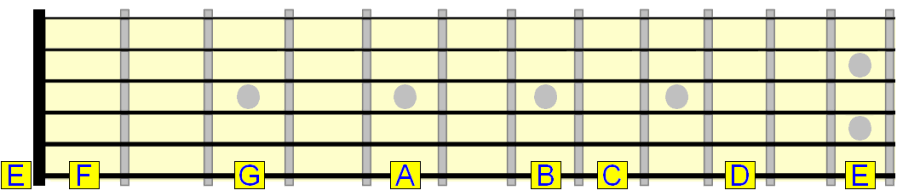
Starting with the low E string, let's first learn the natural notes...

low E string natural notes on a guitar
  • The open E string gives us a low E note. The 12th fret E is the same note, but an octave higher in pitch.
  • F note at the 1st fret
  • G note at the 3rd fret
  • A note at the 5th fret
  • B note at the 7th fret
  • C note at the 8th fret
  • D note at the 10th fret
Remember, the note cycle repeats beyond the 12th fret octave, so the 13th fret will be the octave of (same note as) the 1st fret F. The 17th fret will be the octave of the 5th fret A. See if you can find these note octaves beyond the 12th fret.


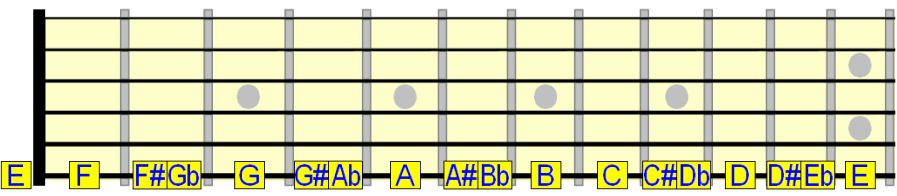
All we need to do is fill in the gaps with the sharps/flats from the table earlier. Again, don't worry about whether to use a sharp or flat at this stage, just memorise the positions of these enharmonic notes...

6th string note including sharps and flats

  • F sharp / G flat at the 2nd fret
  • G sharp / A flat at the 4th fret
  • A sharp / B flat at the 6th fret
  • C sharp / D flat at the 9th fret
  • D sharp / E flat at the 11th fret
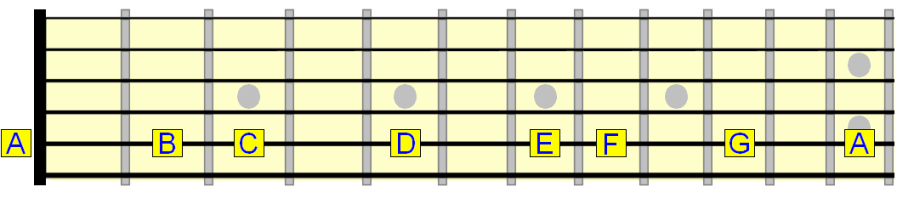
Now the A string. Again, memorise the natural notes first, starting from the open A string...

A string natural notes on the fretboard
  • A note on the open string. The 12th fret A is an octave higher.
  • B note at the 2nd fret
  • C note at the 3rd fret
  • D note at the 5th fret
  • E note at the 7th fret
  • F note at the 8th fret
  • G note at the 10th fret
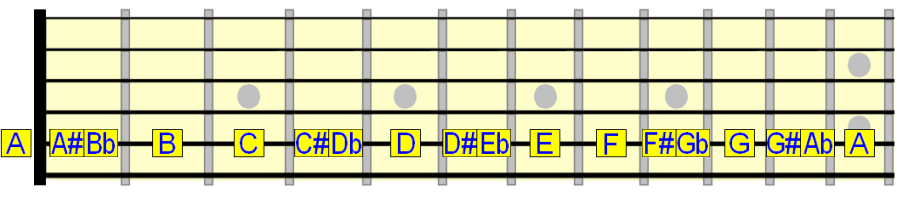
I think you get the idea now! Fill in the flat/sharp gaps.

A string notes including sharps and flats
  • A sharp / B flat at the 1st fret
  • C sharp / D flat at the 4th fret
  • D sharp / E flat at the 6th fret
  • F sharp / G flat at the 9th fret
  • G sharp / A flat at the 11th fret
If you want, you can apply exactly the same method for memorising the notes on the other strings. Remember, the same sequence of notes exist on the high E string as on the low E, just in a higher octave pitch (the high E string notes are 2 octaves higher than the low E string notes).

So that just leaves the D, G and B strings.

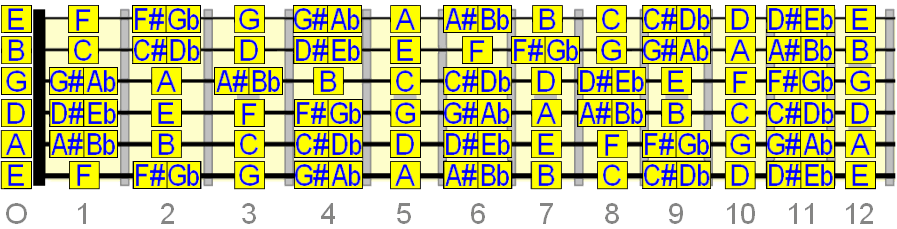
The below diagram shows the completed fretboard with the fret numbers beneath (O is for open string).

full fretboard notes


Help with fretboard note memorisation


To test your knowledge, try the following exercise. Pick any note in your head and see if you can locate it on all 6 strings. At first, you'll be slow, but the more you test yourself like this, the quicker and more "automatic" your note identification will become.

Source article: http://www.fretjam.com
Read more

8 Reasons Why Your Guitar Improvisation Does Not Sound Like Music


You have practiced countless hours, you know your scale positions and fingerings like the back of your hand, you can play faster than all your friends. Yet, all the solos you improvise (or write) sound kind of stale, and not like “real music”. Why? Years ago when I was a beginner this problem was driving me crazy. How comes that some people can play just three notes and make them sound like music, while other simply can't, no matter how much or how little they play? I found out that there are many possible things that can go wrong while trying to play melodically. I compiled a list of the most common reasons that prevent your improvisations to sound like music, adding some tips on how to overcome them.
Some of the points that I will be making here are of purely technical nature, while others are on the emotional side of things. A good solo (like all music) is an expression of the player's emotions. Music is a synthesis of technique and art, and in order to be a good musician you need to have something to express (emotion) AND the means to express it (technique. We will start from the technical issues and then we will gradually move to the emotional ones.

 1. Overplaying


The first reason is probably the most common among guitarists (and drummers). Playing too many notes is the defining characteristic of “the obnoxious guitar player (TM)” that other musicians, not to mention the public, dread so much.
It is important to realize that the term “overplaying” has a relative meaning. Some songs may require a slow solo, while others will call for a solo with a lot of notes and fast runs. Not all fast guitarists are automatically guilty of overplaying. A shred solo DOES require lots of notes, and if the song is composed so that it sets up the solo properly then even the fastest solo can’t be considered overplaying. It is a matter of context and taste.
The solution here is ridiculously simple: just play fewer notes! Train yourself to improvise over a backing track using only 1-2 notes per bar. If the backing track is in 4/4, this means one note every 2-4 beats. It seems easy, but if you try it in practice you will discover that you have to resist the urge to speed up. Do not give up!
  1. When overplaying the superfluous notes obscure the melody line. Actually some people play too many notes trying to hide the lack of melody in their solos!
  2. It is not very important how fast you can play, but how much is the difference between the slowest and the fastest note you can play. If you can give a lot of contrast between slow and fast passages, the fast passages will seem faster.
  3. It is generally a good idea to keep your fastest licks for the end of your solo/improvisation. If you play them too soon you will have nothing else to entertain the listener afterward.


2. Phrasing


Now that you have your foot firmly on the brake and not overplaying, you will start to notice that slow notes may not actually sound that good by themselves. If you feel the urge to play fast to hide this, resist it. The problem does not lie in the fact that you are playing slowly: the culprit is your lack of familiarity and training with long notes. Yes, you heard me correctly. Many of us spend lots of practice time in order to play faster (an endeavor that I applaud), but how many of us actually practice to play ONE good long note?

If you practice with only one note at your disposal you will soon discover that the rules of the game are different. It's not anymore only WHAT you play, but also HOW you play it (i.e. your PHRASING). The two most common problems that guitarists encounter in this respect are 1) bends not in tune and 2) bad vibrato (too fast, too narrow, not regular). If you are doing the exercise I suggested above, i.e. improvising just with few long notes, you may start to notice these issues. If so, that is GREAT! Only if you hear the problems in your playing you can fix them. I will not expand too much on the topic of bends and vibrato here, since it is a topic that requires a lot of space and there are already good articles on the web about that. What I will say here is: set aside some time in your daily practice routine to practice exclusively single notes with bends and vibrato. A good vibrato is the signature of any good player.

3. Not targeting chord notes

Of course, even if HOW you play it is very important, WHAT you play still retains a certain importance (random notes are not everyone's favorite melody). Even if you are playing in the right key with good phrasing, sometimes your improvisation fails to “glue” to the chord progression in the backing track. This happens because at any given moment in music some notes are more “right” than others. The short story is: the “right” notes are the ones that are included in the chord that is playing in that moment (the so-called “chord tones”). If this last statement is not clear to you, I am going to clarify it in a minute. In the meantime, let me state an important fact: in general you are NOT restricted to play only “right” notes. In fact, you can play literally whatever you want as long as you stop on a “right” note (this last statement has a lot of exceptions but it's a good starting point). This is the meaning of the often cited quote “there are no wrong notes, only wrong resolutions” attributed to at least 20 different Jazz musicians.

Now, let's clarify this concept: chords are composed by at least three notes. For instance the C major chord is made by the notes C, E, G. So, if the backing track is playing a C major chord on a certain moment, I have to finish my phrases on a C note, or an E note or a G note. If the chord changes, my “target notes” change too. At the beginning this seems hopelessly difficult to manage (after all you have to 1. know what chord is playing right now; 2. remember the notes of this chord; 3. find them on the fretboard; and 4. play them, all at the same time!). With a bit of structured training this becomes very easy. All good players have practiced targeting chord notes until it became second nature. The key to understand it is to use some visual guide, like the following diagrams that show the chord notes for Am and C in the Am pentatonic scale.
pentatonic scale with chord tones

Of course, this is just a very short introduction and a complete explanation of this topic would be quite lengthy. complete with guided backing tracks, explaining step-by-step this chord tone thing with practical exercises that will let you play effortlessly following this concept in just a little time (IF you will follow the exercises, of course!).


4. Not playing with other musicians


As I am fond of saying, music is a team sport. While you can certainly have some fun by yourself, it is not even close to the fun you can have playing with other people (or FOR other people, as we will see below). With this I do not mean that you have to play only with other guitarists, but also with bass players, drummers, singers, keyboard players, in fact any kind of musicians you can find.

I know what many of you are thinking right now: “But I am still not good enough to play with other people / have a band”. Well, let me be blunt here: if you do not go out and play with other people, you may NEVER become good enough! You can’t learn how to swim if you do not enter in the water. If you want to learn how to play basketball you can’t do it alone. You may not be good enough to enter the NBA yet, but you can surely find someone in your neighborhood that will play with you. The same goes for music.

You will discover very soon that when you are playing with other musicians, the dynamics of your playing is completely different. You have to adapt to what other people are doing, react to their music, and give your own interpretation. Lots of good players have honed their skills by playing in bands, and you should do the same. By the way, this is also one (but not the only) reason to have a good teacher: you will be playing regularly with someone better than you.

5. Not listening

One corollary of “music is a team sport” is that when you are playing with other musicians you have to LISTEN (and in general pay attention) to what and how they are playing. How can you tell if you are paying attention to the other musician (or the backing track)?
  1. You find yourself looking at your fretboard all the time and not at the other musicians, you are not paying enough attention. Good musicians look at each other all the time.
  2. If you start improvising as soon as the backing track/band starts, you are not listening.  Good musicians let few bars pass before improvising to absorb the feel, the tempo and the chord changes of the song. 
  3. If you are just waiting “for your turn to play”, you are not listening.

A good way to learn how to listen is called “to trade fours”. You need another guitarist to do this. While playing together, for 4 bars you will be playing the rhythm and he will be soloing, for the next 4 bars you will invert the roles and so on. Your task is to play something in context with what he just played, ideally making it seems like there is only one soloist and not two.

6. Not training with backing tracks


Even if you wanted to, you can't play with other musicians all the time. Every good athlete trains with his team but also on his own, and we musicians should do the same. Backing tracks offer a non-interactive simulation of a band that can help you train a quantity of different things. You can play them as many times as you want: they will never be tired of repeating the same thing. On the other hand, backing tracks are less inspirational and less fun than playing with a real band. For that reason backing tracks are not a substitute of playing with other people, yet they can still be useful.

Training with backing tracks should be part of your daily routine, but you should not just blindly improvise over the backing track. You should have in mind a technique or a concept that you want to implement in your playing, such as: “Just few notes with a good vibrato” or “let's try to implement this lick I just learned”. Personally, I think backing tracks are incredible for learning the “right” notes to play, as explained above. The problem is that you should know the chord progression of the backing track beforehand to be able to target the chord tones. To solve this problem I prepared a set of “guided” backing tracks where I spell out the chord while they are playing. Once you have learned the chord progression by heart you can use the “plain” version. 

As strange as it may seem, this is one of the main factors in making your improvisations sound like music. If you are just playing for yourself you have nobody to communicate with, so your music does not sound genuine. If you are playing to impress other musicians, as often happens in a jam session, your music will sound artificial.  But if you are playing in front of a public, then more often than not you are playing to tell them something, to establish a connection. You can gauge your improvisation by observing the reaction of the public, so the communication is two-way.

I know some players (and I am among them) whose improvisations are mildly boring when they are alone (for instance, while they are recording in their studio), but when in front of a real public they become able to deliver good solos. This is because they are focusing on communicating with the public rather than being self-centered on their technical ability.
Now, before you think “I will never be able to step on a stage”, let me specify that with “public” I do not necessarily mean 10.000 paying people in a stadium. Two or three of your friends is enough public to get this started: ask them and they will be happy to listen to you. Again, do not wait to be good to do this otherwise you may never become good.

8. Not having something to express


This is probably the more “esoteric” point I am making here, but it is the definite factor that makes your improvisation jump from “very good” to “mind-blowing awesome”. This is, if you think about it, the whole reason why we are playing an instrument. Just stop for a moment now and think to the last song you listened today before reading this (or the song you are listening to right now). Does this song have a meaning or an underlying emotion? Of course it has one. What is the meaning of that song? I am sure that it is not difficult for you to answer this question, after all we all listen to music because it give us emotions or it tells us stories.

It is essential that your playing should tell something, or have an underlying feeling or emotion to it, yet very few people actually practice this. Wait a moment, did I just say you should PRACTICE emotions? Yes, I did utter such a blasphemy. And here is how we are going to do it.

Take your guitar, and using only three notes, try to express the deepest sadness you can. What notes are you using? How are you playing them? You have only three notes, you better choose and play them well! Now, do the same trying to express a calm serenity. Then try to express anger. Then express regret. Joy. Trepidation. Impatience. Boredom. Wittiness. Tiredness. Humor. Amusement. All of them using only three notes.

Make a list of other emotions you want to express. If you can’t find a word for that emotion, describe a situation that gives you this emotion (“Summer afternoon reading a book under the shadow of a tree”, “driving a fast car”, “running the last mile of a marathon”, etc), then try to express it using only 3 notes. Notice that there is not one right answer, rather there are many. With all the answers you collect from a single emotion, you can compose a solo.
In the end
Some of these points may apply to your situation, and some of them may not. You may need to work on the technical side of things (like the chord notes, or your phrasing) or you may need to work on your self-expression. I hope you have found here something useful for you. Take what you need and discard the rest. Stop playing notes and start playing music!


About the author: Tommaso Zillio is a professional guitarist and teacher in Edmonton, AB, Canada. Visit http://www.tommasozillio.com for more information on Tommaso and to check out his free guitar newsletter.
Read more